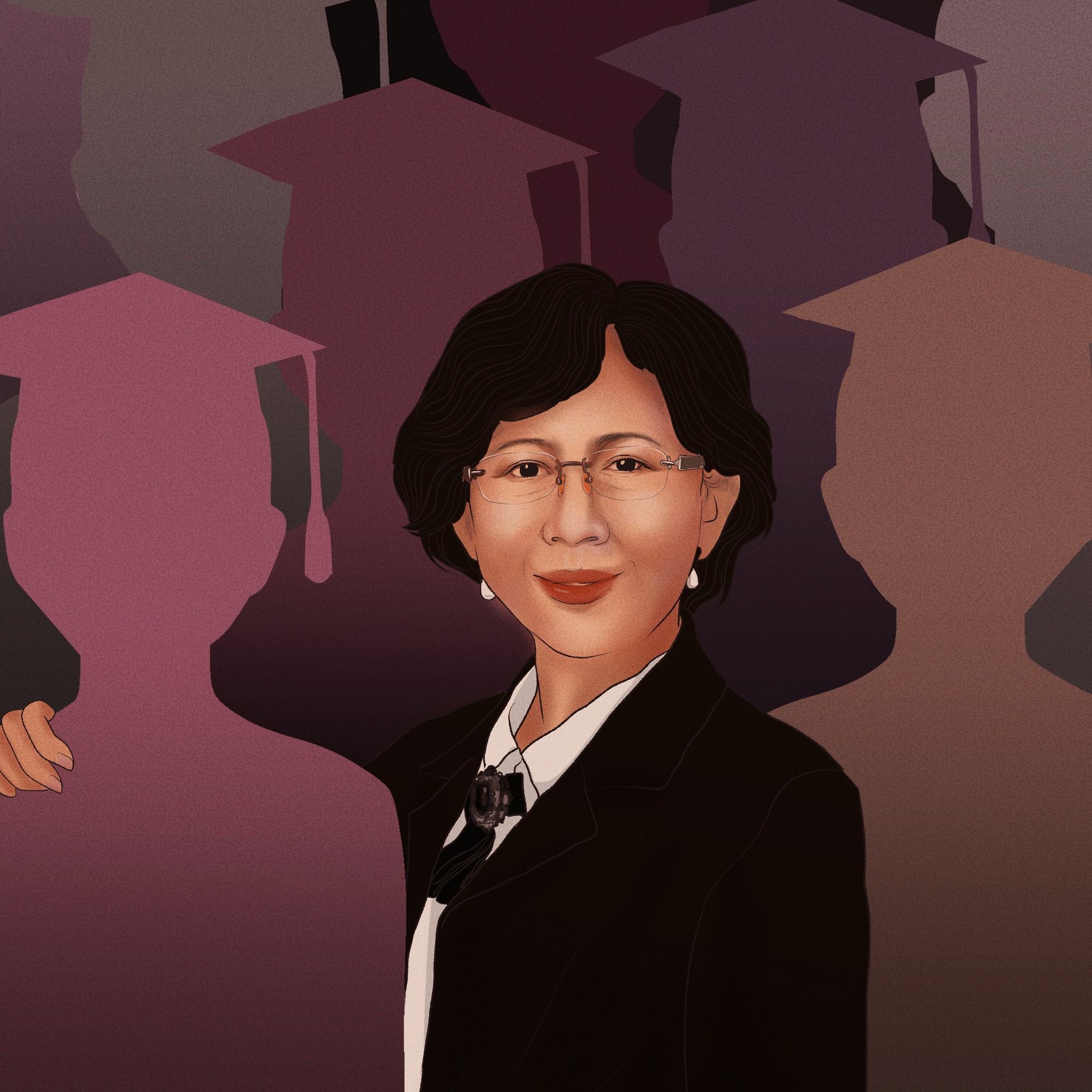
©Rona/Bal
Inaugurated on Friday (27-5) at the UGM Senate Hall by the Academic Senate (SA), Ova Emilia became the Rector of Gadjah Mada University for the 2022-2027 period. A mountain of unfinished issues awaits Ova, raging from infrastructure development, sexual violence management, and the high cost of education.
Long before the inauguration, on (12-05), in front of Ghra Sabha Pramana, students failed to meet the three Rector Candidates. Initially, they had planned to stage a demonstration to deliver a list of UGM’s unresolved issues to the candidates who had passed the SA’s selection process. However, until the process concluded, the three candidates declined to meet the demonstrators.
Sulistiowati, Chairperson of the SA; Paripurna Sugarda, Vice Rector for Cooperation and Alumni Affairs; and Panut Mulyono, UGM Rector for the 2017-2022 period, came to meet the students as representatives of the Academic Senate session for the rectoral selection. Carrying the students’ aspiration, they tried to respond. “They’re our own children who want to express their aspirations, of course we should listen,” said Paripurna.
Paripurna’s statement reflects the narrative of “bapakisme,” a paternalistic discourse often used to suppress student movements. By referring to students as “children,” he positions the university as the “parent” figure. The paternalistic logic of “bapakisme” places students in a subordinate position—those who are expected to obey the “parent”. This relationship confines the student movement within a moral narrative and obscures the real issues they are trying to raise.
So then, how does the new rector view the relationship between the university and its students? On (15-07), Balairung Team had the opportunity to meet directly with UGM’s 17th Rector. As the 1987 alumna of UGM’s Faculty of Medicine, Public Health, and Nursing, she shared her perspective as rector in this issue during the interview at the Rector’s Office in UGM’s Central Building.
As a Rector, how do you view UGM?
I view UGM from a historical perspective. The first educational institution owned by Indonesia was UGM. Therefore, UGM represents Indonesia on the global stage. UGM’s mission also differs from that of other universities because in addition to carrying out the Tri Dharma of Higher Education, UGM also conducts research that produces innovations and benefits for society.
How do you view the relationship between the university and its students?
I have explained in the last hearing1 that students are partners—partners who sit together with us in pursuing a shared mission. They are not objects, but rather part of the subject in solving problems. Therefore, in making every policy at UGM, students must be involved, as they are ultimately the ones who will be most affected by those policies.
During the selection process of Prospective Rector Candidates, Paripurna Sugarda said that the relationship between the university and students is like parent and child. How does the parent-child relationship relate to the partnership you described earlier?
The partnership I mentioned earlier should be viewed through our own cultural perspective. I see students as my own children. When seen through the parent-child relationship, this sense of partnership is not about domination. Parents are considered successful when they can build cooperation with their children. Parents must fulfill their children’s needs to help them achieve their goals. This means that the children’s success is also due to their parents’ contribution. Therefore, the older generation should care for the younger, and the younger should respect the older.
How would you respond to the students’ criticisms?
I am used to receiving criticism because my own children also like to criticize me. However, criticism should not be expressed carelessly, it should be constructive. Students may have perspectives that I might not be aware of. Express those thoughts properly, and as a parent, I will listen and initiate discussion. That is why, in the previous hearing, I requested that the forum be held every three months.
Then, why did you not meet with the students during the previous selection of Rector Candidates?
I did not think it was necessary. At that time, I was still going through the selection process, it was not certain that I would be the elected rector. For me, criticism is acceptable because you have the right to criticize. However, it should be delivered in an appropriate way. There was no need to do it in such a manner.
Earlier, we talked about the relationship between the university and the students. Now, how do you view the relationship between the university and the state?
Since UGM’s development is funded by the state, UGM also has a responsibility to support the state. In this case, we have a constitutional duty to uphold the Tri Dharma of Higher Education as part of the university’s responsibilities. As the first higher education institution in Indonesia, we remain committed to supporting the state. This can be done by providing input through research and supervision that other initiators may not conduct in proposing solutions to national problems. Thus, a university not only generates ideas but also ensures the safeguarding of the state’s interests.
You mentioned that UGM’s development funding comes from the state. Then, how do you justify the Voluntary Contribution for Institutional Development (Sumbangan Sukarela Pengembangan Institusi or SSPI) policy that collects funds from students?
According to the legal regulation, that is permitted specifically for students admitted through the independent admission. Many of these students come from well-off families who are willing to make contributions. Therefore, to accommodate such funding, we categorize it as a voluntary contribution. For comparison, tuition fees at private universities are extremely high—even entering a private medical school can cost up to half a billion rupiah. Some public universities have even dared to set fees as high as 600 million rupiah, and such figures have never appeared in UGM’s records. This implies that if we don’t apply a similar system, we’ll fall behind due to insufficient funding.
As the election year approaches, many UGM’s alumni will compete in politics. How does UGM position itself?
We are proud that our alumni play roles in contributing to the nation. As an independent institution, we uphold integrity and maintain objectivity throughout the electoral process. For instance, when providing input or opinions, we must maintain an academic approach and refrain from taking sides with any political faction.
How about the other UGM’s alumni or academics who support policies that don’t serve the public interest, such as Panut Mulyono who served on the 2020 Omnibus Law Task Force?
It’s great to have such studies, because conducting them is not easy, since they must be grounded in academic objectivity and constructive value for the nation. For instance, in medical studies, there are often differing opinions among academics. I think this is a challenge for UGM to provide input that is measured and evidence-based, instead of being driven by assumptions. Take the example of tobacco research; debates are inevitable, and we must approach it comprehensively. When discussing tobacco, the World Health Organization withdrew any previous support or recognition given to UGM. On the other hand, from taxation and agricultural perspective, tobacco plays a major role in generating state revenue while also serving as a source of livelihood for millions. Therefore, it is important to examine all perspectives in such studies. Sometimes students tend to see matters from only one perspective due to limited knowledge. Thus, such studies need to be expanded so that students can view issues from various perspectives.
Author: Ilham Maulana
Editor: Bangkit Adhi Wiguna
Illustrator: Rona Iffah
Translator: Chuzaima B.
Notes
[1] Hearing means open forum with students.
