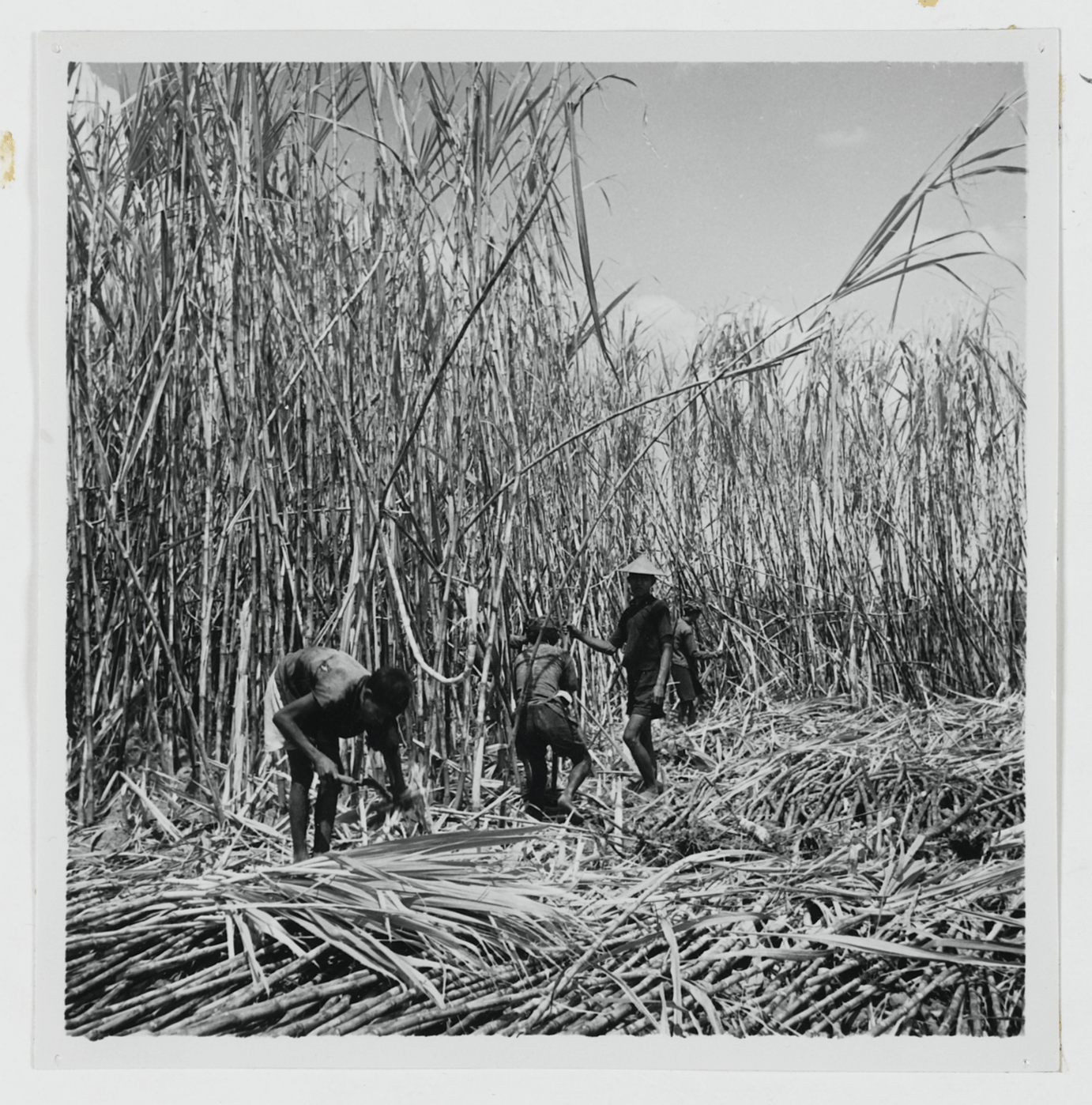
Snijden van suikerriet op een onderneming in de buurt van Jokjakarta [Menebang tebu di sebuah perkebunan dekat Yogyakarta-red], circa 1920. © Istimewa/KITLV 18277
Unable to bear witnessing the workers’ exploitation by the sugar factories, Soerjopranoto launched a series of strikes that kept entrepreneurs awake at night from 1915 onward. Yet it was only after nearly five years that the movement gradually faded, as subsidies were issued and wages were raised.
Introduction
The liberal economic policies imposed by the Dutch East Indies Government in 1870 did more than just yielding colonial super profit for European plantation owners. They also deepened the cycle of shared poverty among the bumiputera or the indigenous Javanese population (Achdian 2008: 18). The stark disparity between the colonial elite and the bumiputera people arose from the proletarianization of small landless peasant and land-owning farmers, who were gradually forced to hand over their lands to industrial interest under predatory lending schemes. This proletarianization scheme was carried out so systematically that it eventually pushed the once self-sufficient agrarian communities into wage labor in both public and private sectors, severing their agrarian roots and traditional modes of subsistence. The relentless drive for economic gain led to the implementation of this production system without consideration for local cultural values. Consequently, bumiputera communities residing in semi-urban areas found themselves uprooted from their agrarian heritage[1].
Ironically, the increasing participation of bumiputera laborers as the lowest tier of the industrial workforce did not translate into fair wage policies. From the perspective of the colonial administration, the bumiputera people were perceived as indolent, believed to survive on meager daily earnings—merely “sebenggol sehari”[2]. This starkly contrasted with European and Chinese laborers, who were paid significantly higher wages. The injustice in wage policies ignited a series of localized protests throughout the 1880s (Utomo, 1983: 68–78). Although these protests began to incorporate strike methods, they largely remained traditional in nature, as no well-structured labor organizations had yet emerged. Furthermore, these labor movements were geographically limited in scope, restricting their overall impact.
The term “An age of strikes” (Zaman Mogok), as coined by Takashi Shiraishi (1997: 47), refers to a period in the late 1910s and early 1920s when a wave of labor strikes swept across sugar factories in Java, particularly in Yogyakarta, Central Java, and East Java. These strikes were orchestrated by the Personeel Fabrieks-Bond (PFB), a federation of six sugar factory labor unions founded by Soerjopranoto in 1918 in Yogyakarta, with demands for both “material and spiritual improvement” (De Locomotief, February 4, 1919). The sugar factory strikes under the PFB banner marked the first large-scale labor resistance carried out by bumiputera workers since proletarianization took hold of Javanese society in the wake of the Post-liberal Period. For the first time, Yogyakarta emerged as a pivotal center of the movement. By the late second decade of the twentieth century, political activists no longer operated solely in Semarang or Surabaya, as numerous national organizations and labor unions had established their headquarters in Yogyakarta. When the age of strikes erupted, the once-feudal royal territories or vorstenlanden, long steeped in aristocratic tranquility suddenly reverberated with a wave of meetings, strikes, and political propaganda.
While in the early 20th century, Yogyakarta was a region brimming with political and social upheaval. Strategically positioned, it played a crucial role in shaping both the labor movement and the broader nationalist movements. However, Yogyakarta’s significance as a center of labor activism has received little scholarly attention. Historical bias has led to an overemphasis on left-wing labor movements in Semarang, often equating labor struggles with communism. This narrative overlooks the nationalist-led labor movement in Yogyakarta, which was driven by the Centraal Sarekat Islam (CSI) (Blumberger, 1932: 135).
Historical Sketch of the Sugar Factories in Yogyakarta
Colonial labor studies frequently begin with the rise of private enterprises following the implementation of the Open Door Policy in 1870. The emergence of the liberal class and their strong opposition to the Cultivation System (Cultuurstelsel) ultimately pressured the colonial government to abandon it, a shift marked symbolically by the passage of the Agrarische Wet of 1870 (Sulistyo, 1995: 12). This new economic climate, favorable to foreign capital, encouraged sugar capitalists to invest heavily in the interior regions of the Dutch East Indies. However, the situation in the vorstenlanden was distinct. Even before 1830, Chinese and European entrepreneurs had already leased land from local rulers and lungguh (hereditary landholding) holders in these regions (Siraishi, 1997: 12). Decades before the liberal class rose to prominence, Dutch entrepreneurs had already operated indigo, tobacco, and sugar plantations in Yogyakarta and Surakarta, facilitated by land lease agreements formalized in the 1857 State Gazette No. 116 (Soemardjan, 1985: 214). For the Surakarta region, coffee must be added to the list of these goods, which at that time was not available in Yogyakarta.
Despite the existence of land leasing for industrial purposes long before the Liberal Period, the land available for lease in the vorstenlanden remained relatively limited. Between 1830 and 1850, Surakarta never leased more than 50,000 bau; approximately 35,000 hectares by calculating at that time 1 bau was equal to 0,7 hectares; while Yogyakarta’s leased land never exceeded 15,000 bau (Siraishi, 1997: 12). This figure increased steadily toward 1870, though it remained modest. By 1864, 200,000 bau of land were rented in Surakarta, significantly more than Yogyakarta’s 46,000 bau in 1862. By the time foreign investment was fully liberalized in 1870, Yogyakarta had 58 plantations, including 8 sugar estates. Although this was far fewer than Surakarta’s 137 plantations (31 of which cultivated sugar), reports from the early 20th century indicate that Yogyakarta’s sugar production outpaced that of other Central Java regions, including Surakarta, in terms of sheer volume.
The commercialization of land intensified with the liberalization of foreign investment in 1870. Major corporations rushed to establish sugar factories in areas that would later develop into urban centers. The land they acquired for sugar plantations was largely owned by lungguh holders, who had the legal right to lease portions of their land under specific conditions. Initially, lease agreements were limited to twenty years, but over time, these contracts were extended to thirty years with renewal options (Soemardjan, 1985: 214). This allowed sugar capitalists to gradually assume roles previously held by local aristocrats, even extending their influence over bekel (village administrators).
The land leasing system implemented at the time required a rotational management arrangement between landowners and tenants. This system, known as geblagan, granted each party the authority to manage the land for 12 months (Soemardjan, 1985: 227). However, from the outset, all parties involved in the contract were well aware that cultivating sugarcane within a mere 12 months was virtually impossible. Sugarcane requires at least 17 months to mature before it can be harvested and processed at the mill. Consequently, tenants often exceeded the agreed-upon lease period. While the original target for returning land management rights was set for May, in reality, the process could not be completed before September. Ironically, the compensation provided to cover the five-month gap—during which farmers had no income—was minimal. This situation led to widespread frustration among the peasantry.
The expansion of plantation areas alongside the establishment of sugar processing factories fueled an increasing demand for both skilled and unskilled labor in factory and plantation sectors alike. This, in turn, attracted landless farmers to settle around industrial zones. The dominance of capital power not only reshaped labor dynamics but also eroded long-standing traditional structures within rural communities. The patron-client relationships between tenant farmers and landowners began to weaken, access to communal resources within villages became more restricted, and supplementary incomes from traditional agrarian activities dwindled (Achdian, 2008: 20). In this way, the influx of foreign capital gradually spurred the process of urbanization in Yogyakarta.
Between 1913 and 1920, Yogyakarta ranked just below Surabaya, Pekalongan, and Pasuruan in sugar production. As previously noted, the land allocated for industry in Yogyakarta was not as extensive as in Surakarta. However, this did not automatically make Surakarta the largest sugar producer in the vorstenlanden region. A report from early 1917 revealed that despite having less leased land, Yogyakarta’s sugar production still surpassed that of Surakarta in terms of quantity (De Locomotief, January 18, 1917). This suggests that private entrepreneurs, constrained by limited plantation land, prioritized intensification over extensification. As a result, the industry required more labor while maintaining wage allocations that did not overly burden the companies (Breman, 1986: 49). This process of proletarianization underscores how economic liberalization primarily benefited sugar capitalists, while the bumiputera population remained trapped in low-wage labor.
Low production costs were the key to the colonial government’s extraordinary profits. An Australian newspaper reported concerns over the meager wages of sugar factory workers in Java, which stood in stark contrast to the island’s booming sugar production (Queensland Times, March 23, 1917). In another report, the same newspaper presented a table detailing Java’s sugar production between 1896 and 1906. The data illustrated an almost twofold increase within a decade, from 534,390 tons to 1,048,275 tons (Queensland Times, December 28, 1907). The report concluded with a poignant remark: “But the secret of Java’s progress in sugar production is finally traceable to their great natural advantages together with the fact that the cost of labour is lower than any other part of the sugar producing world.”
The New Social Class Politics
The expansion of industrial activity inevitably spurred modernization across various aspects of life in Yogyakarta. The establishment of sugar factories in nearly every kawedanan district marked the early characteristics of an emerging urban landscape. By the second decade of the 20th century, Yogyakarta had 18 sugar factories spread across the city and its surrounding regions, including Sleman, Bantul, Gunungkidul, and Kulonprogo. Prior to this, in the latter half of the 19th century, railway networks were developed to facilitate the distribution of goods, alongside the construction of highways reaching deep into the interior. Notably, highways played a critical role in shaping the city’s identity, as they were closely linked to the emergence of commercial districts and elite residential areas. Although electricity was still limited in use, rural communities began transitioning toward an urban lifestyle, adopting new paradigms and ways of thinking.
Among all these transformative factors, none proved more influential for the bumiputera population than education. The growth of educational institutions from the late 19th century was driven by the colonial rulers’ and European entrepreneurs’ demand for skilled and educated labor. Schools began to emerge in Yogyakarta in the latter half of the 19th century, albeit with limited student enrollment. The colonial government took a more systematic approach to education under Resident Mullemeister (1822–1891) (Surjomihardjo, 2008: 67). However, significant advancements were not achieved until the introduction of Eerste Klasse and Tweede Klasse schools, which aimed to accommodate bumiputera students. Additionally, higher education institutions in fields such as medicine, teaching, law, and engineering were established to meet the growing need for trained professionals.
Though initially designed to provide cheap educated labor for the colonial system, the expansion of education inadvertently gave rise to a new social class—one that developed national consciousness and the ability to articulate this awareness through Western-style rhetoric and activism. A pivotal moment in the awakening of national consciousness came in 1908 with the establishment of Boedi Oetomo by students of STOVIA, a medical school for bumiputera students. Even before these future Javanese doctors took the initiative to form what would later become a rather conservative organization, other bumiputera figures had already begun their movements through the press. Over time, journalism played a crucial role in fostering national awareness among the bumiputera population. Abdurrachman Surjomihardjo (2008: 206) argued that modernization in colonial society was the result of a synergy between the press and emerging socio-political organizations, both of which were fueled by expanded access to education. This new social class, which leveraged its education to cultivate national awareness through the press and political organizations, came to be known as the “professional communicators” (Surjomihardjo, 2008: 203).
One such professional communicator was Soerjopranoto, born on June 11, 1871. As the eldest son of KPA Soerjaningrat, a nobleman from Pakualaman, he could have lived a life detached from the struggles of the common people. Instead, after completing the Klein Ambtenaaren Cursus (a training course for junior civil servants), he was assigned to work in the Controleurs Kantoors, where he directly witnessed the systemic discrimination faced by bumiputera low-ranking officials (Budiawan, 2006: 48). After furthering his education at the Middelbare Landbouwschool (MLS) in Bogor and working in Wonosobo, he ultimately decided to dedicate himself to the nationalist movement, joining Boedi Oetomo (Budiawan, 2006: 64–68). His growing concern for labor rights led him to become one of the most prominent labor activists of the colonial era.
In 1915, Soerjopranoto co-founded Arbeids-leger (Labor Army) Adhi Dharmo alongside Raden Djojodiwirjo, Raden Sastrowijono, and Raden Muso (Sulistyo, 1995: 44). Initially, this group focused on advocating for labor rights within a limited scope. A key tool in their struggle was Medan Boediman, a publication that allowed Soerjopranoto and his peers to voice their demands and ideas on labor issues.
On several occasions, Adhi Dharmo successfully organized labor strikes to demand higher wages, improved benefits, and better working conditions. One of their most notable successes was a strike at the Tandjongtirto Sugar Factory in 1918 (Utama, 2017: 3). The adoption of strikes as a method of resistance marked a shift toward Western-style labor movements, contrasting sharply with earlier forms of protest, such as the burning of sugarcane plantations (Suhartono, 1995).
Building on his success with Adhi Dharmo, Soerjopranoto established a more extensive sugar factory workers’ union in 1918—the Personeel Fabrieks Bond (PFB). From early 1919, the organization expanded its network across various regions, and by the end of the year, he successfully consolidated sugar factory workers across Java to stage mass strikes. Initially, these strikes occurred sporadically in different locations, but the colonial government’s neutral stance—steering clear of direct political interference—allowed most of them to yield positive results. Due to his remarkable ability to organize strikes, the colonial press dubbed him the “Staking-koning” or the “Strike King.”[3]
New Gace for Labors Movement
The labor movement did not initially take root in Yogyakarta. Instead, its early origins can be traced back to Semarang, where a group of railway workers formed a union known as SS Bond in 1905. This organization was not intended as a revolutionary force and, lacking a clear agenda, quickly faded into obscurity. However, the landscape of labor activism changed in 1908 with the establishment of the Vereniging van Spoor-en Tramwegpersoneel (VSTP), a new railway workers’ union. Over time, VSTP grew increasingly progressive, largely influenced by the rising communist ideology among Semarang’s workers. The arrival of Henk Sneevliet, a Dutch communist, further solidified the ideological direction of the union. Among his most promising protégés was Semaoen, who emerged as a skilled propagandist. By the turn of the 20th century, Semarang had established itself as a stronghold of labor activism, with VSTP as its dominant union, setting the stage for the so-called “age of strikes” in Java.
Yogyakarta emerged as a new center of labor activism when the Perserikatan Pegawai Pegadaian Bumiputera (PFB) expanded its influence in 1919 (Siraishi, 1997: 148). That year marked the official formation of the first hoofdbestuur (central board), led by Soerjopranoto as chairman, Soemodihardjo as secretary, and Soemoharjono as treasurer (Siraishi, 1997: 150). The union quickly established local branches, each with its own propagandist serving as a regional representative. Within a short span, PFB’s membership skyrocketed—from just 700 members in December 1918 to 8,000 by the following year, with 2,000 more awaiting registration (McVey, 2017: 58). The organization’s influence spread across Java, particularly in Yogyakarta, Central Java, and East Java, making these regions the epicenter of a surge in labor strikes between 1919 and 1920.
As the labor movement in Java evolved, it became increasingly divided between nationalist-leaning activism in Yogyakarta and communist-led efforts in Semarang[4]. Internal conflicts within Sarekat Islam intensified this divide, leading to a rivalry between Soerjopranoto and Semaoen. Tensions came to a head during the 1919 congress, which resolved to unite scattered labor unions across Java under a single federation. This initiative resulted in the formation of Vakcentrale, also known as the Perserikatan Pergerakan Kaoem Boeroeh (PPKB) (McVey, 2017: 58). Despite failing to steer PPKB towards communism, Semaoen was elected as its leader, while Soerjopranoto had to settle for the vice-chair position. However, Semaoen struggled to consolidate control over the entire labor force, a weakness that Soerjopranoto and Agoes Salim capitalized on by relocating PPKB’s headquarters to Yogyakarta.
With the nationalist faction of the Central Sarekat Islam (CSI) now at the helm of the labor movement, Yogyakarta solidified its status as the new nerve center of labor activism. While the city had long hosted significant congresses, it was only in 1919 that it truly emerged as a beacon of the movement. Whenever a PFB branch planned a strike, its representatives would travel to Yogyakarta to seek propagandist aid or simply advice. Nonetheless, the leftist faction in Semarang continued to play a role in labor agitation. By 1920, as strikes intensified, the communist-aligned newspaper Soeara Ra’jat openly expressed support for these actions. Reports from the publication revealed that the strikes were not limited to sugar factory workers but also included employees of the newspaper De Locomotief. Contemporary sources further indicated that nearly one-third of all sugar factories in Yogyakarta had been affected by labor strikes, underscoring the growing momentum of the movement.
The Era of Strikes and the Rise of PFB’s Influence
The era of strikes began when the PFB (Perserikatan Fadjar Baru) launched its propaganda in 1919. Prior to this, several smaller-scale strikes had already taken place, such as the one in Tandjoengtirto in 1918, which was initiated by Adi Dharmo. As the momentum for strikes built up, Yogyakarta recorded sixteen operational sugar factories, as reflected in the production reports of that period (De Nieuwe Vorstenlanden, December 29, 1919).
Among these sixteen factories, at least six experienced labor strikes. This number may have been even higher, given the limited availability of strike-related documentation and the tendency of some factories to be grouped together under the same corporate ownership. The majority of these strikes resulted in significant victories for the workers, particularly in securing wage increases.
The Strike at Gesiekan Sugar Factory
Gesiekan was among the first sugar factories to witness a labor strike. The protest unfolded between early February and March 1920, driven by workers’ demands for higher wages. By the second week of March, the factory’s manager conceded to these demands. The outcome was so noteworthy that Soerjopranoto publicly expressed his gratitude through the press (De Locomotief, March 16, 1920).
Like many other colonial-era strikes, the Gesiekan protest was quickly labeled as a communist movement. Concerned about the revolutionary potential of the striking workers, factory owners chose to grant their demands promptly. However, at the same time, in both Gesiekan and Gondanglipoero, the local bourgeoisie organized a counter-movement, forming what they called a “Boemipoetra association,” explicitly aimed at resisting revolutionary factions (De Locomotief, March 19, 1920).
The Strike at Gondanglipoero Sugar Factory
Gondanglipoero, much like Gesiekan, held an equally formidable revolutionary potential in the eyes of factory owners. However, Soerjopranoto observed that “the only company that made favorable exceptions was Smutzer’s Gondanglipoero, a well-known Volksraad member. There, workers received—or were about to receive—bonuses, old-age pensions, health insurance, and better housing. In short, everything needed in the modern era” (De Locomotief, April 17, 1920). Nevertheless, strikes and negotiations also took place in this region, with their outcomes being promptly accepted by workers in early March 1920 (De Locomotief, March 11, 1920).
The Strike at Padokan Sugar Factory
Padokan, now Maduksimo, was one of the major sugar factories in Bantul, and it remains operational to this day. During the widespread strikes of 1920, the factory was among those that resisted workers’ demands. As of April 12, approximately sixty workers were still on strike (De Preanger Bode, April 14, 1920). On April 17, De Locomotief reported that the strike erupted because factory management refused to recognize PFB’s consular representatives in negotiations. The strike finally ended on April 22 (De Preanger Bode, April 13, 1920).
The Strikes at Demakidjoe and Rewoeloe Sugar Factories
The strikes at Demakidjoe and Rewoeloe occurred simultaneously, immediately following the conclusion of the Padokan strike (De Preanger Bode, April 24, 1920).
The Strike at Tandjongtirto Sugar Factory
The Tandjongtirto strike was the last to take place in Yogyakarta, unfolding a full month after the failure of the general strike across Java. Despite this, it remained a highly charged movement, with at least half of the factory’s total workforce participating, approximately 80 to 160 laborers. The strike dragged on due to the intervention of the assistant resident, whose threats against Soerjopranoto only inflamed tensions further (Bataviaasch Nieuwsblaad, September 27, 1920). Police forces were stationed in Wringin to monitor the situation, yet factory operations continued as usual (Bataviaasch Nieuwsblaad, September 23, 1920).
The Jubilee of Sugar Factories Labor Movement
The colonial government generally maintained a neutral stance toward the strikes that erupted across Java. Officials consistently emphasized that the demands of sugar factory workers were reasonable and deserved to be met. This position inadvertently allowed strikes to spread sporadically across the region. Government support also encouraged most companies to concede to the strikers’ demands. Even the employers, represented by the Sugar Syndicate, seemed relatively unbothered by the labor unrest, as no legal disputes arose from the strikes.
However, behind this seemingly lenient attitude, sugar capitalists harbored a strategic intent to weaken the labor movement. This goal materialized through the establishment of the Politieke Economische Bond (PEB) in January 1919, spearheaded by A.J.N. Engelenberg (Sobari, 2008: 33). The PEB [5] emerged as a direct response to the labor struggles led by the PFB (Personeel Fabrieks Bond). Tensions quickly escalated between the two organizations, as their agendas sharply contrasted. While the PFB consistently advocated for wage increases and worker resistance against employers, the PEB sought to co-opt discontented laborers by offering incentives such as wage hikes and access to education. Despite its seemingly benevolent mission, the PEB’s primary aim remained the suppression of labor militancy.
The broader narrative promoted by the PEB and the colonial bourgeoisie centered on the assimilation of bumiputera workers into European culture. This assimilation strategy involved extending privileges typically reserved for Europeans—such as access to education, improved irrigation, and migration opportunities—to select segments of the bumiputera population. Proponents of the Ethical Policy, including Indo-European elites, played a key role in pushing this agenda. Their ultimate goal was to pacify bumiputera activism, preventing it from escalating into political movements that could threaten colonial rule. While economic grievances—such as demands for higher wages—were tolerated, any attempt to translate labor unrest into political mobilization was swiftly discouraged. Yet, from its inception, the labor movement was inherently political. The debate over whether workers should engage in politics became a major discourse in the 1930s. John Ingleson (2013) argued that the bourgeois lifestyle significantly influenced the political militancy of workers during this period.
“The psychological horizon of urban workers also shifted in other directions. With the rise in the number of graduates from Malay-Dutch schools entering the workforce, and with Indonesian manual laborers taking on jobs previously reserved for Europeans, an aristocracy of skilled laborers began to emerge in the 1910s. Many of these workers were at least semi-literate. They became targets of advertisements that encouraged them to consume more, visit cinemas, and adopt a broader perception of the world. In general, they aspired to and expected higher living standards. These skilled laborers formed the backbone of trade unions, especially in auxiliary branches, and after 1918, they fought relentlessly to maintain their living standards in the face of soaring inflation.”
It took some time for factory owners and government officials to recognize this reality. However, once they did, they devised strategies aimed at pacifying skilled workers through higher wages and additional incentives. This approach occasionally proved effective and played a significant role in the dissolution of the Sugar Factory Workers’ Union after 1921. It also contributed to growing divisions among teachers and pawnshop employees regarding income disparities and hierarchical positions (Ingleson, 2013: 124–125).
Bambang Sulistyo (1995: 180) concurs that a sense of satisfaction with the movement’s achievements was one of the key factors behind the decline of the PFB movement following the 1920 strike. According to him, the wave of strikes in the sugar industry gradually subsided in parallel with an increasingly synchronized social and economic landscape (Sulistyo, 1995: 180). Once workers secured what they desired—at the very least, a wage increase—the need for further mobilization diminished in their eyes.
Staking-Konning’s Abdication
The dwindling attention of sugar factory workers toward Soerjopranoto’s propaganda was inevitably followed by a decline in PFB membership. The situation worsened as the colonial government adopted a more repressive stance, issuing a series of prohibitions against public meetings. Soerjopranoto was well aware of the weakening labor movement under his leadership. He believed that recognition from both sugar industry employers and the colonial administration was crucial for PFB to function as a mediator between workers and management. However, despite his persistent efforts, this recognition remained elusive.
As a last resort, Soerjopranoto planned a general strike across Java. He issued an ultimatum to sugar industry employers, demanding a 100 percent wage increase for workers. Should this demand be ignored, a general strike would commence on August 17, 1920. The employers, however, dismissed the ultimatum outright. The sluggish momentum of the movement and PFB’s unpreparedness ultimately led to the strike being called off when Soerjopranoto found an opportunity to withdraw. As a result, the colonial press ridiculed the ultimatum and the planned strike, branding it as nothing more than an empty jest.
It was only a matter of time before PFB’s movement reached its end. The steady decline in membership, coupled with the government’s repressive measures, severely dampened the workers’ morale. By 1921, the PFB had faded into near obscurity. The labor movement was subsequently taken over by left-wing groups in Semarang, culminating in a major strike in 1923. However, this leftist movement, too, met its demise following the crackdown on communism, triggered by their premature rebellion in 1926.
Conclusion
The plight of workers, once reaching a point of stagnation, would persist unless a figure emerged to galvanize collective consciousness and mobilize action. The realization that a group is being oppressed by a systemic force requires certain conditions to be translated into concrete actions capable of bringing about change. In colonial-era Yogyakarta, the labor struggle was not only about securing better wages and working conditions but also about igniting a broader movement that inspired workers in other regions to unite in pursuit of economic justice.
Unfortunately, this movement lacked the resilience to sustain its demands amid shifting social dynamics. As social hierarchies flattened and workers gained new rights, their consumption patterns began to reflect their integration into a restructured production system. Once workers were pacified, capitalists regained the freedom to dictate the terms of labor. This pattern was evident in the sugar factory labor movement, which ultimately reached an anticlimax. The overreliance on leadership and the absence of militant resolve led to the premature decline of the colonial-era sugar factory labor movement before it could achieve significant change.
Author: Han Revanda Putra
Editor: M. Ihsan Nurhidayah
Translator: Ester Veny
Translator Notes:
[1] This is quite contrary to the analysis of Clifford Geertz and J.H. Boeke, both of whom tended to argue that capitalist economic development had no significant impact on non-capitalist economic activities. However, several recent studies have shown that the development of capitalism in the Dutch East Indies had a huge impact on the lives of the majority of farmers in rural Java. See Andi Achdian, op. cit., p. 19.
[2] Just a pittance per day; this expression appears for the first time in the Council of the Indies, October 26, 1932. At that time, the director of domestic administration said, “Gebleken is dat he thans voor volwassenen mogelijk is, zich voor 2 1/2 cent per dag te voden.”
[3] John Ingleson assessed that this moniker was actually written in a disdainful tone in Dutch-language newspapers, but was full of admiration in nationalist and labor newspapers. See John Ingleson, Buruh, Serikat, Politik: Indonesia pada 1920an—1930an, (Tangerang Selatan: Marjin Kiri, 2015), p. 126.
[4] Petrus Blumberger divided the factions within the vakcentrale into “het communistische Semarang of wel het nationalistische Jogja”. See Blumberger, Petrus, De Nationalistische Beweging in Nederlandsch-Indië, (Utrecht: Tjeenk Willink, 1931), p. 135.
[5] In the vernacular, the Semarangan group mocked the PEB with the phrase “Politik Ekor Babi” (Pork Barrel Politics) and supported the strike movement launched by PFB Soerjopranoto. See Soeara Ra’jat, March 16, 1920.
References
Archival and Newspapers Source
Bataviaasch Niewusblaad, 1920.
De Economische Ontwikkeling van Ned-Indië in Cijfers en Grafieken, 1938.
De Locomotief, 1920.
De Nieuwe Vorstenlanden, 1920.
De Preanger Bode, 1920.
Historische Prijzen in Nederlandsch-Indië Sedert 1825, 1939.
Haagsche Courant, 1920.
Jaarcijfers voor het Koninkrijk der Nederlanden 1920, 1922.
Kolonial Verslaag, 1920.
Soeara Ra’jat, 1920.
Article, Book, and Theses Source
Blumberger, Petrus. De Nationalistische Beweging in Nederlandsch-Indie, (Utrecht: Tjeenk Willink, 1931)
Breman, Jan. Penguasaan Tanah dan Tenaga Kerja: Jawa di Masa Kolonial (Jakarta: LP3ES, 1986).
Budiawan. Anak Bangsawan Bertukar Jalan (Yogyakarta: LKiS, 2006).
Farid, Hilmar dan Ahmad Nashih Luthfi (ed.). Sejarah/Geografi Agraria Indonesia (Yogyakarta: STPN Press, 2017).
Ingleson, John. Buruh, Serikat, dan Politik: Indonesia pada 1920an—1930an (Tangerang: Marjin Kiri, 2015).
Ingleson, John. Perkotaan, Masalah Sosial, dan Perburuhan di Jawa Masa Kolonial (Depok: Komunitas Bambu, 2013).
McVey, Ruth T., Kemunculan Komunisme Indonesia (Depok: Komunitas Bambu, 2017).
Novita, Angghi. “Gerakan Sarekat Buruh Semarang Tahun 1913—1925,” (Semarang: Universitas Negeri Semarang, 2015).
Padmo, Soegijanto. “Ekonomi Perkebunan dan Keresahan di Pedesaan: Sebuah Survai Awal”, Humaniora, no. 2, 1995.
Semaoen, The Indonesian Movement in the Netherland Indie, tt.
Shiraishi, Takashi, Zaman Bergerak: Radikalisme Rakyat di Jawa, 1912—1926 (Jakarta: Pustaka Utama Grafiti, 1997).
Suhartono, Bandit-Bandit Pedesaan di Jawa Studi Historis 1850–1942 (Yogyakarta: Aditya Media, 1995).
Sukarno, “Orang Indonesia Tjukup Nafkahnja Sebenggol Sehari?”, dalam Dibawah Bendera Revolusi I (Jakarta: Panitya Penerbit, 1964)
Sulistyo, Bambang. Pemogokan Buruh: Sebuah Kajian Sejarah (Yogyakarta: Tiara Wacana, 1995).
Sulistyo, Bambang. “Pasang Surut Gerakan Buruh Indonesia,” Lensa Budaya 13, no. 2 (2018).
Susanto, Harris. Matinya Sang Buruh (Depok: Penerbit Koekoesan, 2012).
Sobari, Bernas. Partai Politik Campuran di Hindia Belanda: Politieke Economishe Bond 1919—1929 (Jakarta: Universitas Indonesia, 2008).
Soegiri DS dan Edi Cahyono, Gerakan Serikat Buruh: Jaman Kolonial Hindia Belanda Hingga Orde Baru (Jakarta: Hasta Mitra, 2003).
Soemardjan, Selo. Perubahan Sosial di Yogyakarta (Yogyakarta: Gadjah Mada University Press, 1986).
Tedjasukmana, Iskandar. Watak Politik Gerakan Serikat Buruh Indonesia (Jakarta: TURC, 2008).
Utama, Danang Indra. “Pemogokan Buruh Pabrik Gula Tanjung Tirto Tahun 1918,” Skripsi, Yogyakarta: Universitas Negeri Yogyakarta, 2017.
